

Group Medical Insurance for Small Business Employees: Choosing the Right Coverage
What makes a group health insurance plan the right choice for your employees? Is it affordable premiums, a broad provider network, manageable out-of-pocket costs, or coverage that genuinely meets your employees’ healthcare needs?
Choosing group medical insurance for small business employees means balancing all of these considerations while keeping your business’s benefits budget in check. With different plan types, coverage levels, contribution strategies, and provider networks to compare, finding the right fit can quickly become more complicated than simply choosing the lowest premium.
The good news is that you don’t have to figure it out alone. GoBenefits helps small businesses compare group medical insurance options, review costs and coverage, and choose benefits solutions that align with their workforce and budget.
Understanding Group Medical Insurance for Small Businesses
Group medical insurance allows a business to provide health insurance coverage to eligible employees through an employer-sponsored plan. Employers may contribute toward premiums, while employees may pay a portion based on the plan and contribution structure.
When evaluating group health insurance for small business employees, consider:
- Premiums and contributions
- Deductibles and out-of-pocket costs
- Provider networks and prescription coverage
- Plan types and coverage levels
- Employee healthcare needs
The goal is to choose health insurance coverage that meets employee needs while remaining affordable for the business. GoBenefits helps small businesses compare plans, costs, and coverage options to make informed benefits decisions.
Types of Group Health Insurance Plans for Small Businesses
When comparing group health insurance for small businesses, employers may encounter several plan types, each offering a different balance of cost, flexibility, and provider access.
- HMO Plans: Health Maintenance Organization (HMO) plans generally use a defined provider network and may require primary care providers or referrals, depending on the plan.
- PPO Plans: Preferred Provider Organization (PPO) plans generally offer greater provider flexibility and may provide out-of-network coverage at a higher cost.
- EPO Plans: Exclusive Provider Organization (EPO) plans generally cover care within a defined network, with limited out-of-network coverage except in specific situations such as emergencies.
- HDHPs: High Deductible Health Plans (HDHPs) generally have higher deductibles and may offer lower premiums and, depending on eligibility, can be paired with a Health Savings Account (HSA).
The right plan depends on your workforce, budget, and overall benefits strategy. GoBenefits helps businesses compare HMO, PPO, EPO, and HDHP options based on coverage and costs.
Factors Affecting Group Medical Insurance Costs for Small Businesses?
If you’re researching small business affordable group health insurance, cost is likely one of your first questions.
The important thing to understand is that there isn’t a single price that applies to every business. Premiums and total costs can vary depending on the workforce, location, plan design, coverage, contribution strategy, and available carrier options.
Premium Costs
Several factors can influence the costs of group health insurance for small businesses, including:
- Number of eligible employees
- Employee and dependent enrollment
- Geographic location
- Selected plan design
- Coverage level
- Provider network
- Employer contribution
- Employee contribution
- Carrier and plan availability
Rather than relying on a generic estimate, businesses should obtain quotes based on their actual workforce and coverage requirements.
We help businesses compare group health insurance quotes based on company size, location, coverage needs, and employee benefits requirements.
Employee Contributions
Depending on the employer’s contribution strategy, employees may pay part of their health insurance premiums.
This makes it important to evaluate employee health insurance plans for small businesses from the employee’s perspective as well.
Ask:
- How much will employees pay each month?
- What will they pay when using healthcare?
- Are deductibles manageable?
- Are preferred providers included?
- Does the plan provide useful prescription coverage?
A plan may be affordable for the employer, but it can still feel expensive to employees if their share of premiums and out-of-pocket costs is too high.
Deductibles and Other Out-of-Pocket Costs
Premiums don’t tell the entire cost story.
Employees may also be responsible for:
- Deductibles
- Copayments
- Coinsurance
- Prescription expenses
- Out-of-network costs, depending on the plan
- Other eligible cost-sharing amounts
That’s why comparing total plan value is more useful than comparing monthly premiums alone.
Why Plan Value Matters More Than Premium Alone
The best group medical insurance for small business employees isn’t always the plan with the lowest premium.
Imagine two plans with different premiums. One costs less each month but has a higher deductible and narrower network. Another costs more but provides broader provider access and lower employee cost-sharing.
The better choice depends on what your employees actually need and how the total costs fit your business’s benefits budget.
A useful comparison should look at:
Premium + employer contributions + employee costs + coverage + provider network + plan features
GoBenefits’ insurance quoting platform is designed to help businesses compare group health insurance plans, review premiums and coverage levels, and make more informed decisions based on their workforce.
How to Choose the Right Group Medical Insurance Coverage
Knowing what to compare is one thing and how to choose group medical insurance is another.
Use the following process to evaluate your options.
1. Understand Your Employees’ Healthcare Needs
Start with your workforce.
Consider:
- Preferred providers
- Healthcare access
- Prescription needs
- Specialist access
- Different employee circumstances
- Employee expectations around costs
The goal isn’t to find coverage that looks good on paper. It’s to find coverage employees can realistically use and value.
2. Establish Your Benefits Budget
Determine what your business can comfortably contribute toward health insurance.
Having a defined budget makes it easier to eliminate options that aren’t financially practical while focusing on plans that provide the right balance of cost and coverage.
3. Compare Employer and Employee Contributions
Don’t evaluate business costs separately from employee affordability.
Review how much the business contributes and how much employees will be expected to pay.
This can help you create a benefits package that is competitive without putting unnecessary pressure on either side.
4. Compare Coverage and Cost-Sharing
Review premiums alongside:
- Deductibles
- Copays
- Coinsurance
- Out-of-pocket maximums
- Prescription coverage
Looking at these elements together provides a clearer picture of what the plan could actually cost.
5. Review Provider Networks
A health plan is only useful if employees can access the providers they need.
Check whether the plan includes relevant doctors, hospitals, specialists, and other healthcare facilities.
6. Compare Available Plan Options and Quotes
Don’t make your decision based on the first quote you receive.
Compare multiple group health insurance plans for small businesses and look at both price and coverage.
We simplify this stage by bringing insurance quoting and plan comparison into one platform.
Businesses can compare options from leading national carriers and review plan types, premiums, deductibles, out-of-pocket limits, and network coverage.
7. Think Beyond the Initial Purchase
Choosing the plan is only the beginning.
Your business will also need to manage:
- New-hire enrollment
- Employee terminations
- Qualifying life events
- Employee contribution changes
- Payroll deductions
- Eligibility updates
- Open enrollment
- Renewals
This is one reason benefits administration should be part of your initial decision.
ACA Considerations for Small Business Health Insurance
ACA requirements can become increasingly important as a business grows and its workforce changes. Employer obligations may vary based on workforce size, employee status, and the type of coverage offered.
Key considerations can include:
- Employee eligibility and affordability
- Applicable employer requirements
- ACA reporting and required forms
- Accurate employee and coverage records
GoBenefits provides ACA compliance support for applicable large employers and self-funded groups, including tools for affordability tracking, lookback measurement, and 1094/1095 reporting.
How GoBenefits Helps Small Businesses Choose Employee Health Coverage
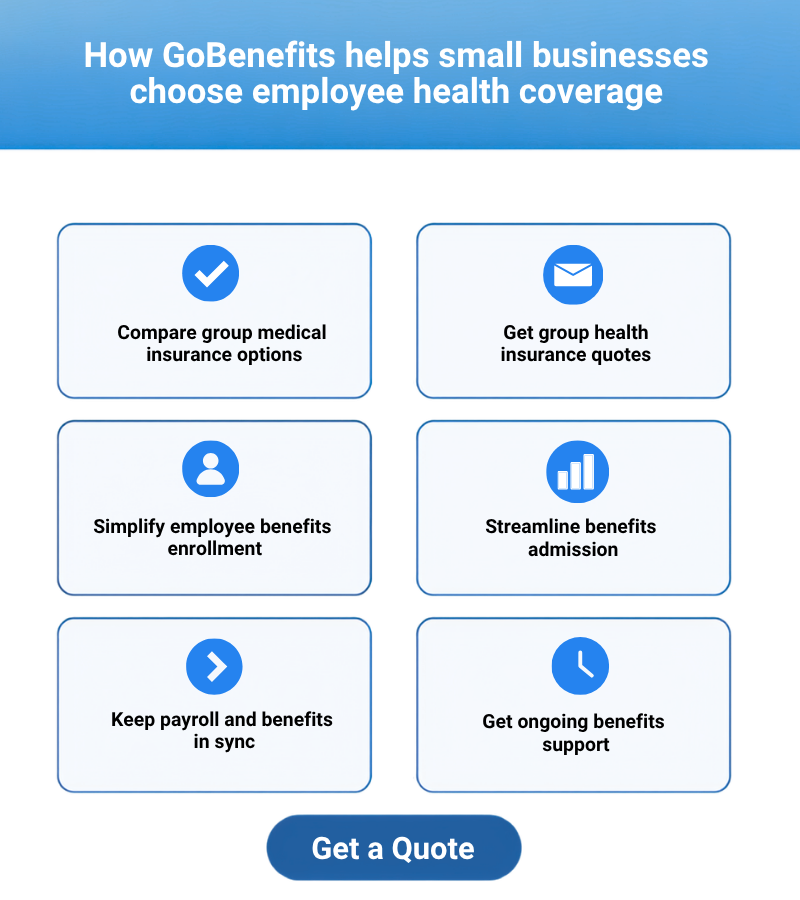
Choosing group medical insurance for small business employees involves more than selecting a plan and paying the premium. Employers also need to compare coverage, understand costs, manage enrollment, and handle ongoing benefits administration.
Compare Group Medical Insurance Options
Finding the right plan starts with understanding what’s available. Businesses can compare group health insurance plans for small businesses based on:
- Premiums and employer contributions
- Coverage levels and plan types
- Deductibles and out-of-pocket costs
- Provider networks
- Other plan features
This helps employers look beyond the lowest premium and evaluate the overall value of their coverage.
Get Group Health Insurance Quotes
Comparing actual quotes is an important step when choosing group medical insurance for small business employees. GoBenefits provides an online quoting process that helps businesses review available plans and compare coverage and costs based on their needs.
This can be especially useful for businesses that are:
- Offering employee health coverage for the first time
- Reviewing an existing benefits strategy
- Comparing alternative plan options
- Looking for more cost-effective coverage
Simplify Employee Benefits Enrollment
Selecting coverage is only the beginning. Employees also need an easy way to review their benefits and complete enrollment.
Our online enrollment platform supports:
- New-hire enrollment
- Open enrollment
- Qualifying life events
- Employee benefit selections and updates
Simplify employee benefits enrollment with one platform giving employees a convenient self-service experience while helping employers manage benefit selections, track changes, and keep documentation organized digitally.
Streamline Benefits Administration
As a business grows, manually managing employee benefits can become time-consuming. Eligibility changes, employee contributions, plan selections, and documentation all need to remain accurate.
GoBenefits helps centralize employee benefits through its benefits administration service, keeping employee data, eligibility, enrollment, and payroll deductions aligned.
- Medical benefits
- Dental benefits
- Vision benefits
- Disability benefits
- Supplemental benefits
This gives small businesses a more efficient way to manage benefits as their workforce changes.
Keep Payroll and Benefits in Sync
Accurate payroll deductions are essential for effective benefits administration. When payroll and benefits information don’t align, it can create unnecessary administrative work.
Integration with QuickBooks Online to support processes such as:
- New-hire enrollments
- Employee terminations
- Payroll deductions
- Benefits-related payroll updates
This helps keep payroll and benefits information better aligned while reducing manual administrative work.
Get Ongoing Benefits Support
Choosing an affordable health insurance plan is an important decision, but benefits management continues throughout the year. Employers may need help with renewals, employee changes, enrollment, contributions, and other benefits-related needs.
Get the Right Group Medical Insurance for Your Small Business With GoBenefits.
Choosing group medical insurance for small business employees doesn’t have to mean sorting through endless plans, costs, and coverage details on your own. The right solution should give your employees meaningful health insurance coverage while keeping your benefits strategy practical and affordable.
And you don’t have to manage that process alone.
GoBenefits helps small businesses compare plans, obtain insurance quotes, enroll employees, and manage benefits through one streamlined platform. Whether you’re offering health insurance for the first time or reviewing your current benefits, you can get the support you need at each step. Contact us today to discuss your business’s health insurance needs and find coverage that works for your employees and budget.
Ready to compare your options?
Get a group health insurance quote from GoBenefits and find the
coverage that works for both your employees and your business.
Frequently Asked Questions
1. How does group medical insurance work for small business employees?
Group medical insurance allows employers to provide health coverage to eligible employees through a group plan. Employers may pay part of the premium, while employees contribute the remaining amount based on the plan.
2. How much should an employer contribute toward employee health insurance?
The contribution depends on the business’s benefits budget and desired employee affordability. Employers should consider both their contribution and employees’ premiums and out-of-pocket costs.
3. Is the lowest-premium health insurance plan the best option?
Not necessarily. Lower premiums may mean higher deductibles or employee cost-sharing. Employers should compare overall coverage value, provider networks, and total costs.
4. How can a small business compare group health insurance plans?
Compare premiums, contribution levels, plan types, deductibles, provider networks, out-of-pocket costs, and coverage based on employee needs and budget. GoBenefits can help businesses compare plans and obtain group health insurance quotes.
5. Can GoBenefits help small businesses get group health insurance quotes?
Yes. GoBenefits provides a digital insurance quoting process to compare group health insurance plans, review costs and coverage, and receive support from licensed insurance professionals.
6. Does GoBenefits help with employee enrollment?
Yes. GoBenefits provides online benefits enrollment for new hires, open enrollment, and qualifying life events, helping employers and employees manage enrollment digitally.