
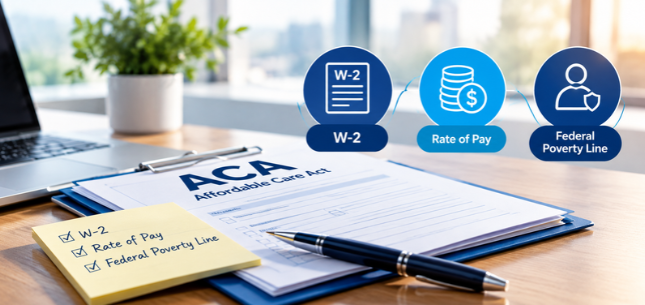
ACA Affordability Safe Harbors Explained: W-2, Rate of Pay and Federal Poverty Line
Offering employee health benefits involves more than selecting a plan and deciding how much the business will contribute. Employers comparing group health insurance providers must also understand Affordable Care Act (ACA) coverage requirements, affordability rules, and how to document compliance.
For the ACA safe harbor 2026 plan year, the ACA affordability threshold is 9.96% of household income. Applicable large employers (ALEs) can use three IRS-approved affordability safe harbors W-2 wages, rate of pay, and the federal poverty line to assess whether employee contributions meet the applicable affordability standard.
For restaurant operators and other businesses with hourly employees, choosing the appropriate method can simplify affordability calculations and support consistent benefits administration.
This guide explains how each safe harbor works, how the calculations differ, and how the GoBenefits ACA Affordability Calculator can help estimate employee contribution limits.
What Are ACA Affordability Safe Harbors?
ACA affordability safe harbors are alternative calculations that eligible ALEs can use to determine whether employer-sponsored health coverage meets the affordability requirement under the employer shared responsibility provisions.
An employer generally qualifies as an ALE if it averaged at least 50 full-time employees, including full-time equivalents, during the preceding calendar year. Businesses under common ownership may need to combine their workforce when determining ALE status under applicable aggregation rules.
ALEs generally must offer minimum essential coverage to at least 95% of their full-time employees and their dependents, and the coverage must be affordable and provide minimum value, or they may face an employer shared responsibility payment if the applicable conditions are met.
Two important terms are
-
Affordability: The employee’s required contribution for the lowest-cost self-only coverage option that provides minimum value must fall within the applicable affordability threshold.
-
Minimum value: The plan must cover at least 60% of the total allowed cost of benefits expected to be incurred under the plan, subject to applicable rules.
The safe harbors use employer-accessible information rather than household income. They do not determine whether coverage is affordable for an employee’s separate Marketplace premium tax credit eligibility test.
Why ACA Affordability Matters for Restaurant Employers
Restaurant businesses that qualify as applicable large employers (ALEs) need to assess their health coverage offers, identify eligible full-time employees, and ensure that coverage meets the ACA’s affordability requirements.
Managing these requirements can be challenging for restaurant operators because their workforces may include:
-
Hourly employees with fluctuating schedules and wages.
-
Different pay rates across job roles and locations.
-
Seasonal staff and frequent employee turnover.
-
Payroll records that must align with benefits eligibility and ACA reporting.
Understanding ACA requirements for employers helps restaurant operators assess employee premium contributions and manage their compliance responsibilities. When evaluating group health insurance, employers should also consider plan costs, employee eligibility, and how contributions affect affordability.
For more industry-specific guidance, read our guide to restaurant employee health insurance.
How to Calculate ACA Affordability Using the Three Safe Harbors
An ACA affordability calculator for employers can help compare estimated contribution thresholds under the three methods before employers finalise their health plan contributions.
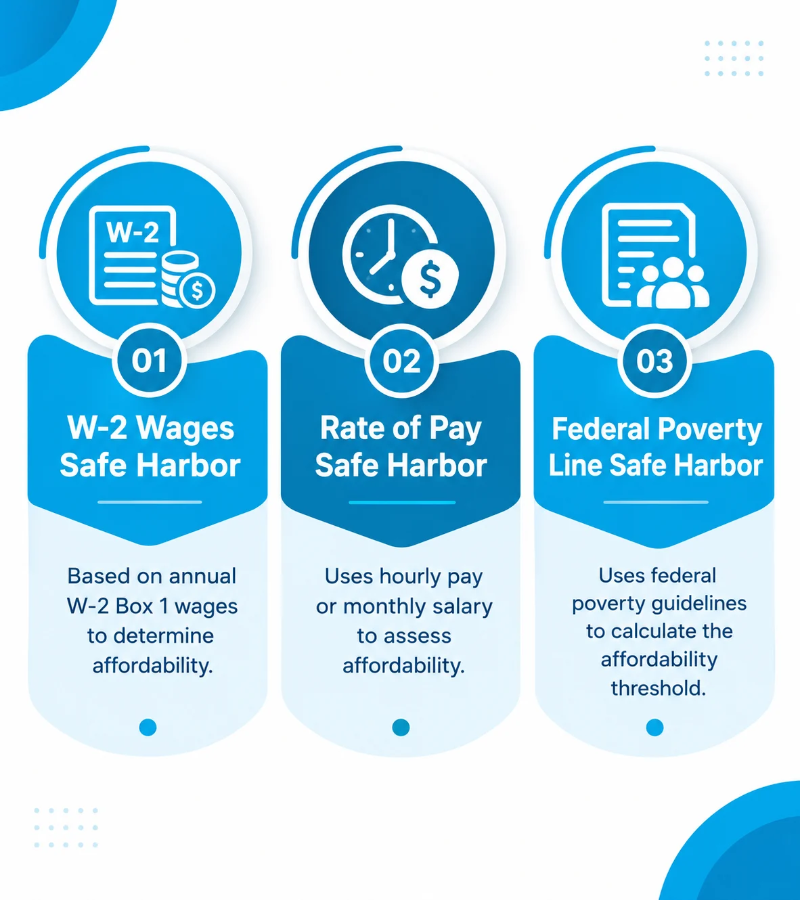
For plan years beginning in 2026 safe harbor rate, the applicable ACA affordability percentage is 9.96%. The formulas below use this percentage for illustration. Employers should verify the applicable plan-year rules and use the correct wage, rate and coverage information.
1. W-2 Wages Safe Harbor: Formula and Example
The W-2 wages safe harbor generally uses the employee’s Form W-2, Box 1 wages to assess affordability.
For a simplified example, assume an employee has $36,000 in Box 1 wages for a full 12-month coverage period.
Annual affordability calculation:
$36,000 × 9.96% = $3,585.60
Dividing by 12 gives an illustrative monthly threshold of $298.80.
The employee’s required contribution must satisfy the applicable W-2 safe-harbor rules. Actual calculations must account for the relevant coverage months and regulatory requirements.
When it may be useful: Employers with reliable year-end wage records may find this method practical.
Limitation: Restaurant workers with variable hours, unpaid leave or changing earnings may have wages that differ significantly over the year. Employers should not assume that projected wages automatically establish compliance.
2. Rate of Pay Safe Harbor: Formula for Hourly and Salaried Employees
The rate of pay safe harbor uses an employee’s rate of pay rather than actual annual earnings.
For hourly employees, the general calculation is:
Hourly rate × 130 hours × 9.96%
For example, an employee earning $18 per hour would have an illustrative monthly affordability threshold of:
$18 × 130 × 9.96% = $233.06
For salaried employees, the calculation generally uses the employee’s monthly salary multiplied by the applicable percentage.
This method can help employers assess affordability for hourly restaurant workers without relying on the number of hours actually worked in a particular month.
However, specific restrictions apply. For hourly employees, the safe harbor rate generally uses the rate of pay at the beginning of the coverage period, with permitted adjustments for decreases but not increases. It cannot be applied indiscriminately when pay rates change or to every employee situation.
3. Federal Poverty Line Safe Harbor: Monthly Contribution Calculation
The federal poverty line (FPL) safe harbor bases affordability on the federal poverty guideline for one individual for the applicable calendar year.
The general formula is:
Applicable annual federal poverty guideline × 9.96% ÷ 12
This produces a monthly employee contribution threshold for the relevant plan year. Employers should use the applicable guideline and verify the calculation for the coverage period.
Why consider this method? It offers a consistent calculation that does not depend on each employee’s individual wages. This can simplify affordability assessments for employers with diverse hourly workforces.
ACA Safe Harbor Comparison: Which Calculation Should You Use?
There is no universally best ACA safe harbor method for every employer. The right choice depends on the workforce, payroll information, plan costs and applicable requirements.
Example: Comparing Safe Harbors for a Restaurant Employee
Consider a restaurant employee earning $18 per hour who is offered self-only coverage under a plan that provides minimum value.
Under the rate of pay method, the illustrative monthly affordability threshold is $233.06. The W-2 method would instead use the employee’s applicable Box 1 wages, while the FPL method would use the relevant federal poverty guideline.
These methods can produce different thresholds because their calculation bases differ. An employer should compare the applicable results against the employee’s required contribution for the lowest-cost qualifying plan option.
The goal is not simply to select the highest threshold. Employers must use a method permitted under the ACA safe harbor rules and apply it consistently within the relevant employee category.
How to Choose and Apply an ACA Affordability Safe Harbor
Before setting employee contributions, employers should:
- Confirm ALE status. Review full-time employees and full-time equivalents from the preceding calendar year, including applicable aggregation rules.
- Identify eligible employees. Review full-time status and applicable measurement methods.
- Review qualifying coverage. Determine the employee cost for the lowest-cost self-only plan that provides minimum value.
- Select a permitted safe harbor. Consider wage data, workforce structure and administrative requirements.
- Maintain records. Document calculations, coverage offers, selected methods and relevant changes.
An ACA affordability calculator for employers can help compare estimated employee contribution limits under the available methods. Verify employee data, safe harbor eligibility and applicable IRS requirements before relying on the results to assess compliance.
Employers may use different safe harbors for reasonable employee categories, provided the applicable uniformity and consistency requirements are met.
Steps to Calculate ACA Affordability Using the GoBenefits Calculator
The GoBenefits ACA Affordability Calculator for employers, helping businesses estimate employee contribution limits under the W-2 wages, rate of pay and federal poverty line safe harbors.
Depending on the calculation, relevant inputs include:
- The monthly premium for the lowest-cost qualifying health plan.
- The applicable federal poverty guideline.
- The employee’s hourly rate.
- Annual W-2 wages reported in Box 1.
The calculator can help estimate the maximum employee contribution under each method and illustrate how the plan premium relates to the employer’s contribution.
For example, if a plan costs $500 per month and the applicable employee contribution is $233.06, the difference is $266.94. This illustrates how the remaining premium could be allocated to the employer if it pays the balance. The actual employer contribution depends on the plan design and contribution arrangement.
Use the calculator as a planning aid, then verify the inputs and applicable ACA rules before finalising contributions.
Common ACA Affordability Calculation Mistakes
Employers should avoid these common errors:
- Using an outdated affordability percentage or the wrong plan-year figures.
- Applying the safe harbor to the wrong employee group or using incorrect wage information.
- Ignoring restrictions on rate-of-pay calculations.
- Confusing affordability with minimum value.
- Assuming every small business is subject to the employer mandate.
- Failing to document coverage offers, employee contributions and selected methods.
An ACA affordability calculator for employers can help identify potential contribution issues, provided employers enter accurate information and verify the results against the applicable rules.
Accurate payroll data, clear processes and regular reviews can help employers manage ACA compliance requirements more effectively.
How GoBenefits Helps Restaurants Manage Health Benefits and ACA Compliance
Managing employee benefits involves more than calculating affordability. Employers also need to compare plan options, coordinate enrollment, maintain eligibility information and handle applicable reporting responsibilities.
As a group health insurance agency, GoBenefits helps businesses navigate health plan options, benefits administration and ACA compliance. Restaurant employers can explore insurance quoting services to compare coverage options and learn more about ACA compliance services for support with applicable compliance workflows.
If you’re evaluating affordable group health insurance for your workforce, read our guide to choosing a group health insurance plan to understand the factors that influence plan selection.
Need help with employee benefits and ACA compliance? Connect with GoBenefits, your group health insurance resource, to explore your options and book your free 15-minute health benefits call.
Frequently Asked Questions
1. What is the ACA affordability percentage for 2026?
The affordability percentage for applicable employer-sponsored coverage for plan years beginning in 2026 is 9.96%. Employers should verify the rules and figures that apply to their particular plan year.
2. Which safe harbor should restaurant employers consider for hourly workers?
The rate of pay safe harbor may be useful for eligible hourly employees because it uses the employee’s rate of pay and 130 hours per month. The W-2 and FPL methods may also be appropriate depending on the employer’s circumstances and applicable rules.
3. Can employers use different safe harbors for different employee categories?
Yes. Eligible ALEs may use different methods for reasonable employee categories if the applicable uniformity and consistency requirements are met.
4. Does using a safe harbor guarantee that an employer will not face an ACA penalty?
No. A safe harbor addresses the affordability test under the employer shared responsibility provisions. Other requirements, including offering coverage to the required percentage of full-time employees and providing minimum value, still apply.
5. How can GoBenefits help with ACA affordability calculations?
The GoBenefits calculator helps employers estimate and compare contribution thresholds. GoBenefits also offers resources and services related to group health insurance, enrollment, benefits administration and ACA compliance.