

How Should Employers Manage Employee Benefits Enrollment for Multiple Locations
Managing employee benefits becomes more complex when a business operates across multiple offices, cities, or states. Employers must coordinate employee benefits enrollment for multiple locations, group health insurance coverage, employee eligibility, and contribution policies while accounting for differences in provider networks and carrier service areas.
A benefits arrangement that works for one office may not provide suitable network access for employees in another state. Differences in carrier availability, plan options, and workforce classifications can also affect which coverage options employers can offer.
A coordinated approach helps businesses compare multi-state employee health insurance options, manage costs, and provide suitable health insurance employee benefits across their workforce.
As a national group health insurance agency, GoBenefits helps employers evaluate coverage options and manage employee benefits through insurance quoting, online enrollment, and benefits administration support.
This guide explains how businesses can coordinate health insurance and employee benefits across multiple locations.
What Are the Health Insurance Options for Businesses With Employees in Multiple States?
Businesses with employees in multiple states generally evaluate whether one group health insurance arrangement can serve their entire workforce or whether different plans are needed for particular locations.
The right approach depends on carrier availability, provider networks, employee locations, plan rules, and the company’s coverage requirements.
One option is a group health insurance plan that includes a multi-state network.
Some insurance carriers offer plans with provider networks that extend across multiple states. This arrangement may allow an employer to provide a consistent group health insurance option to employees working from different locations.
Potential advantages include:
- A consistent core health insurance offering across offices.
- Centralized plan selection and renewal coordination.
- Access to participating providers in multiple geographic markets.
- A simpler framework for communicating coverage options.
However, employers should confirm that the network provides appropriate access to doctors, hospitals, and specialists near each employee’s home or workplace. A network described as national or multi-state does not automatically mean every provider or service is available in every location.
Separate Group Health Insurance Plans for Different States
When one plan cannot adequately serve employees across all locations, employers may consider separate plans or regional coverage arrangements.
This approach may be appropriate when:
- A carrier does not offer the same plan in every state.
- Provider networks vary significantly by location.
- Employees need access to different regional healthcare systems.
- Available plan options differ between geographic markets.
Separate plans can provide more location-specific choices, but employers need to coordinate eligibility rules, contribution policies, enrollment periods, and administration.
Alternative Health Benefits Arrangements
Depending on the workforce and employer’s objectives, businesses may also evaluate arrangements such as an Individual Coverage Health Reimbursement Arrangement (ICHRA).
ICHRA allows eligible employers to reimburse employees for qualifying individual health insurance coverage and eligible medical expenses, subject to applicable rules. It may be worth evaluating when traditional group coverage is not the preferred approach for certain employee populations.
Employers should compare eligibility, affordability, administration, and compliance requirements before choosing an arrangement.
What Are the Advantages of Centralized Employee Benefits Management for Multi-Location Businesses?
Centralized employee benefits management helps businesses coordinate employee eligibility, enrollment, group health insurance coverage, and administration across multiple locations. Employers can establish shared benefits policies while accounting for differences in employee locations and coverage requirements.
Key advantages include:
- Consistent employee benefits: Establish clear contribution guidelines and eligibility rules across offices.
- Centralized benefits enrollment: Coordinate employee plan selections and participation across locations.
- Simplified insurance renewals: Organize group health insurance reviews, carrier comparisons, and renewal planning.
- Affordable employee benefits: Evaluate premiums and benefits expenses against the employer’s budget.
- Flexible health insurance coverage: Account for location-specific carrier availability and provider networks.
A structured approach helps employers manage employee benefits more efficiently while maintaining suitable health insurance coverage across their workforce.
How Can Employers Offer Affordable Employee Benefits Across Multiple Locations?
Providing affordable employee benefits for employers across multiple locations requires balancing group health insurance costs, employee contributions, and access to suitable healthcare providers.
Employers should evaluate:
- Plan premiums and costs: Review monthly premiums, deductibles, and out-of-pocket maximums.
- Carrier and provider networks: Check network availability across employee locations.
- Employer contributions: Consider contribution strategies and employee cost-sharing.
- Employee coverage needs: Assess suitable plan options for different eligible employee groups.
- Renewal options: Review available coverage and pricing changes.
Through its group health insurance quoting service, GoBenefits helps employers evaluate coverage options that balance affordability with employee healthcare needs.
For additional guidance, read Affordable Healthcare Benefits for Employees: What Employers Need to Know.
What Strategies Can Employers Use to Manage Benefits Across Multiple Locations?
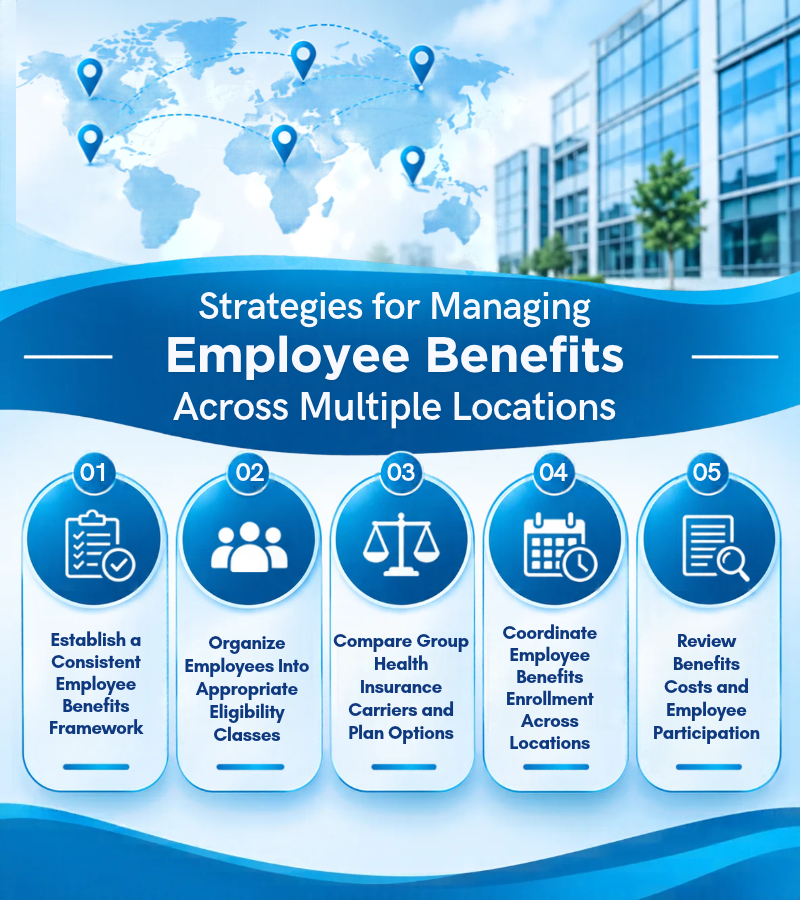
Managing employee benefits across multiple locations requires a consistent process for evaluating multi-state employee health insurance, organizing employee groups, coordinating enrollment, and reviewing benefits costs.
Employers can use the following strategies to manage benefits across different offices while addressing location-specific coverage requirements.
1. Establish a Consistent Employee Benefits Framework
Define the core benefits structure the business wants to maintain across locations. Establish clear guidelines for:
- Available group health insurance and additional benefits.
- Employee eligibility and employer contribution policies.
- Location-specific coverage requirements.
- Benefits review and renewal procedures.
This creates a consistent approach while allowing coverage options to reflect local insurance availability.
2. Organize Employees Into Appropriate Eligibility Classes
Different workforce groups may have different benefit eligibility and coverage requirements. Employers should review their employee classifications before selecting plan options.
Relevant categories may include:
- Full-time and part-time employees.
- Salaried and hourly employees.
- Management and non-management employees.
- Seasonal or variable-hour employees, where permitted.
Classification criteria should be documented and consistently applied in accordance with applicable laws and insurance plan requirements.
3. Compare Group Health Insurance Carriers and Plan Options
Evaluate national and regional carriers based on employee locations and business requirements. Compare:
- Available PPO, HMO, and EPO options, along with suitable HDHP designs.
- Provider networks and carrier service areas.
- Monthly premiums, deductibles, and out-of-pocket costs.
- Employee coverage requirements and plan availability.
GoBenefits supports employers with group health insurance quoting to compare available carrier and plan options.
4. Coordinate Employee Benefits Enrollment Across Locations
Use a consistent enrollment process so employees across different offices receive relevant plan information and understand their coverage choices.
Employers should:
- Communicate enrollment periods and deadlines.
- Provide location-appropriate plan information.
- Coordinate new-hire enrollment.
- Process eligible qualifying life event changes.
- Review employee elections and coverage records.
Online enrollment solutions can help organize these processes and reduce administrative work.
5. Review Benefits Costs and Employee Participation
Regularly review how the current benefits strategy performs across different locations. Monitor:
- Employee enrollment and participation by location.
- Employer and employee premium contributions.
- Annual group health insurance renewal costs.
- Differences in plan availability and employee feedback.
This information helps employers evaluate whether existing coverage remains suitable as their workforce and business locations change.
What Should Employers Compare When Choosing Health Insurance Carriers and Provider Networks for a Multi-State Workforce?
Choosing the right group health insurance carriers for a multi-state workforce requires evaluating more than premium costs. Employers should compare carrier availability, provider networks, plan options, and coverage costs to ensure employees across different locations can access suitable healthcare.
Key factors to consider include
| Comparison Factor | What Employers Should Evaluate |
|---|---|
| Carrier Availability | Do national or regional carriers offer suitable group plans in all employee locations? |
| Provider Networks | Are participating doctors, hospitals and specialists accessible near employees? |
| Plan Options and Designs | Which PPO, HMO and EPO options are available? Are HDHP designs suitable for the workforce? |
| Premium Costs | What are the total premiums and employer and employee contribution amounts? |
| Deductibles and Out-of-Pocket Limits | How much could employees pay for covered healthcare services? |
| Prescription Coverage | Are commonly used medications included in the plan formulary? |
| Employee Eligibility | Can eligible employees in different states enroll in the proposed plans? |
| Benefits Administration | How will enrollment, eligibility updates and coverage changes be managed? |
Employers should also verify provider directories, carrier service areas, and plan documents rather than relying only on general network descriptions. A plan available in multiple states may still have different provider access and coverage rules across locations.
GoBenefits helps employers compare group health insurance plans from national and regional carriers, evaluating premiums, deductibles, provider networks, coverage options, and workforce requirements.
Explore GoBenefits Insurance Quoting to compare available group health insurance options for your business.
How Should Employers Manage Employee Benefits Enrollment Across Different Locations?
Once employers have selected suitable coverage options, they need an enrollment process that works across every office and employee group. A clear process helps employees understand their choices and gives HR teams a more organized way to track elections.
Steps for Coordinating Multi-Location Benefits Enrollment
1. Organize employee information.
Maintain accurate employee records, including work location, residential location, employment status, eligible dependents, and relevant classification details.
2. Confirm available plan options
Identify which plans are available to each eligible employee group. Make sure employees receive information that reflects their location and eligibility.
3. Communicate plan details clearly.
Provide employees with information about premiums, deductibles, provider networks, coverage levels, and enrollment deadlines. Employees should understand the options available to them before making their selections.
4. Coordinate new-hire enrollment
Establish a consistent process for onboarding eligible employees, sharing plan information, and collecting elections within the applicable enrollment period.
5. Track qualifying life event changes.
Create a process for handling eligible changes, such as marriage, divorce, or new dependents. Employees should understand how and when to report these changes.
6. Verify enrollment information
Review submitted elections, employee details, and dependent information. Resolve missing or inconsistent information and confirm that coverage records are accurate.
A digital enrollment process can make these activities easier to coordinate. GoBenefits’ Online Enrollment Service helps employers manage employee benefit selections, documentation, and changes through a centralized platform.
For additional guidance on digital enrollment workflows, read How HR Managers Can Simplify Online Benefits Enrollment for Group Health Insurance Plans.
How Can a Single Platform Help Employers Manage All Types of Employee Benefits?
When a business operates across multiple locations, managing benefits through separate spreadsheets, emails, and disconnected systems can make it harder to maintain accurate records. HR teams may need to track medical coverage, dental and vision elections, employee contributions, eligibility changes, and enrollment documentation.
A centralized platform can bring these activities together and give employers a clearer view of their benefits administration.
Depending on the platform’s capabilities, employers may be able to manage:
- Medical benefits: Group health insurance plan selections and employee coverage information.
- Dental and vision benefits: Additional coverage options and employee elections.
- Disability and supplemental benefits: Other available employee benefit selections.
- Employee eligibility: Records associated with employment status and benefit eligibility.
- Enrollment changes: New-hire elections, qualifying life event updates, and other permitted changes.
- Contribution information: Employer and employee benefit contribution records.
- Benefits documentation: Centralized access to relevant enrollment and coverage information.
A single platform does not replace the need to evaluate carrier networks or confirm plan availability in each state. Instead, it helps organize the administration of the benefits arrangements an employer has selected.
GoBenefits’ Benefits Administration Service helps businesses manage employee benefits, track eligibility, and keep payroll-aligned deductions organized. Its online enrollment platform also supports medical, dental, vision, disability, and supplemental benefit management.
How Do Multi-Location Employers Manage ACA Compliance and Employee Eligibility?
Employers with employees across different states should maintain accurate workforce and coverage records to support applicable Affordable Care Act (ACA) responsibilities.
For applicable large employers, ACA obligations generally depend on factors such as employer size, employee hours, offer of coverage, and affordability—not simply the number of business locations.
A coordinated process can help employers:
- Track employee hours and eligibility information.
- Maintain accurate records of offers of coverage.
- Monitor applicable affordability requirements.
- Apply the appropriate lookback measurement method when used.
- Keep employee coverage information organized.
- Prepare and review applicable Forms 1094-C and 1095-C.
Employers should also review state-specific insurance and reporting requirements where applicable. Federal ACA requirements and state rules should not be treated as interchangeable.
GoBenefits provides ACA Compliance for employees to manage eligibility aca tracking, affordability monitoring, payroll data, and ACA reporting.
See How GoBenefits Helped a Multi-Location Restaurant Group Increase Employee Enrollment by 36%
Managing employee benefits across locations can be particularly challenging for businesses with different brands, job roles, and workforce arrangements. Restaurant organizations, for example, may employ salaried managers, full-time hourly staff, part-time workers, and variable-hour employees across several geographic markets.
A one-size-fits-all benefits approach may not address the needs of every employee group.
GoBenefits worked with a multi-state, multi-brand restaurant and retail organization with 500–2,500 employees. The company was experiencing low participation in certain locations and needed a benefits strategy that better reflected its workforce.
By aligning benefits options with employee classifications and workforce requirements, GoBenefits helped the organization achieve a 36% increase in employee enrollment.
Read the multi-brand restaurant group case study to see how GoBenefits approached its benefits strategy.
How Can GoBenefits Help Employers Manage Employee Benefits Across Multiple Locations?
Managing group health insurance and employee benefits across multiple locations requires careful coordination of carrier selection, employee eligibility, enrollment, and ongoing administration.
GoBenefits combines insurance expertise with benefits technology to help employers evaluate coverage options and coordinate benefits management across different offices, states, and employee groups.
Employers can access support with:
- Group health insurance quoting: Compare available plans from national and regional carriers based on employee locations and workforce requirements.
- Coverage evaluation: Review premiums, deductibles, out-of-pocket maximums, and provider network availability.
- Employee benefits strategies: Evaluate coverage and employer contribution approaches for different eligible employee groups.
- Online enrollment: Coordinate employee plan selections, documentation, and eligible coverage changes.
- Benefits administration: Organize employee eligibility, benefits information, and payroll-aligned deductions.
- ACA compliance support: Manage eligibility information, affordability tracking, and applicable reporting requirements.
Whether your business operates across multiple offices, employs remote workers in different states, or has employees with different job classifications, GoBenefits can help you evaluate and coordinate your multi-location employee benefits strategy.
Visit GoBenefits to learn more about its group health insurance, online enrollment, and benefits administration solutions.
Ready to review your employee benefits strategy?
Book Your Free 15-Minute Health Benefits Call Today, we will discuss your workforce requirements, coverage options, and benefits administration needs.
Frequently Asked Questions
1. Can Employers Offer Different Health Insurance Plans at Different Locations?
Yes. Employers may evaluate different group health insurance plans for eligible employee groups or locations, depending on carrier availability, plan rules, and applicable requirements. The arrangements should be reviewed for consistency and compliance before implementation.
2. How Do Employers Find Affordable Employee Benefits for Multiple Locations?
Employers can compare premiums, deductibles, out-of-pocket maximums, provider networks, and contribution arrangements. Reviewing employee needs and participation across locations can also help identify whether the current benefits structure offers suitable value.
3. What Should Employers Compare When Choosing Multi-State Insurance Carriers?
Employers should review carrier service areas, provider network access, available plan types, premiums, deductibles, prescription coverage, out-of-pocket limits, and enrollment requirements. The comparison should account for every location where employees need coverage.
4. Can a Single Platform Manage Medical, Dental, and Vision Benefits?
Yes, Gobenefits’ benefits administration platform with the appropriate functionality can centralize medical, dental, and vision plan selections, employee records, eligibility information, and enrollment changes. Employers should confirm which benefit types and administrative features the platform supports.
5. How Do Employers Manage Benefits for Remote Employees in Different States?
Employers should confirm where remote employees live and work, evaluate carrier service areas, and identify plans available to eligible employees. They should also maintain accurate employee records and communicate any location-specific coverage options.
6. What Employee Benefits Strategies Work for Multi-Location Restaurant Businesses?
Restaurant employers may evaluate class-based benefits strategies that account for legitimate workforce categories, such as salaried management, full-time hourly employees, and part-time employees, subject to applicable rules. They should also review employee participation and plan affordability and coverage availability across locations.
7. How Can GoBenefits Help Manage Employee Benefits Across Multiple Locations?
GoBenefits helps employers evaluate group health insurance options, compare national and regional carriers, coordinate online enrollment, and organize employee benefits administration. Its services also include support with employee eligibility and ACA compliance. Contact us to discuss your workforce requirements and available benefits solutions.